
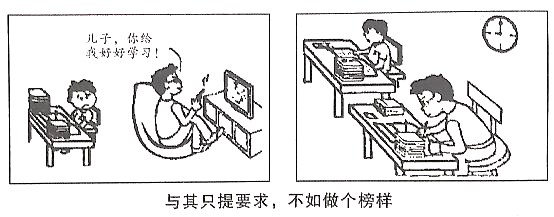
As is depicted in the left picture, with the television on, a father is smoking on the sofa and asking his son to work hard, leaving the boy frowning helplessly. However, the right picture depicts a father and a son immersed in their work respectively, both seemingly content with each other's company. The caption below the pictures implies that example is better than precept.
Incontestably, the pictures shed light on the importance of examples. A fine example has infinite power, which is particularly true in the relationship between parents and children. Family is the most basic unit of education, where parents, the first mentors of their children, should practice what they preach. One reason is that kids like to imitate adults and their thinking process is characterized by concrete images; thus setting examples for kids to follow is more productive. Another reason is that actions speak louder than words. If parents make various requests that they themselves fail to fulfill, how can they ask their children to do so?
As the saying goes,“Parents are the mirror of children." Therefore, they should match words with deeds and set good examples for their children, so as to keep that “mirror”bright and clean all the time.
根据图中文字信息可知,画中人物为父子关系。左图中,叼着香烟的父亲正倚在沙发上悠闲自得地看电视,却要求儿子好好学习,而儿子的面部表情颇具深意;右图中的父亲则以身作则,和儿子一同伏在桌前,认真学习。显然,两位父亲截然不同的表现是这组图画的关键。正如“与其只提要求,不如做个榜样”所述,父母在对孩子提出要求时,应该先审视一下自己是否能够做到。“身教胜于言传”正是这幅图画的寓意。具体写作时,考生可先点明主题,再联系切身实际,论述身教为何会胜于言传。
第一段:描述图画,提炼主题。应将图中两位父亲截然不同的表现作为描述重点,至于“与其只提要求,不如做个榜样”这一信息,无需逐字译出,将其提炼为能体现主题的文字即可。
第二段:围绕主题展开深层分析。首先表明立场——父母应该树立榜样,以身作则;继而分析这样做的原因,如孩子总是会模仿父母、行动比语言更有说服力等。
第三段:总结评论。呼吁父母言行一致,做好子女的明镜。
下附中文范文:
正如左图所示,一位父亲看着电视,倚在沙发上,一边吸烟一边告诉自己的儿子要好好学习;而男孩儿无奈地皱着眉。然而,右图中的父子俩则沉浸在各自的工作和功课中,他们对彼此的陪伴似乎感到很惬意。而图画下方的文字表明:身教胜于言传。
毫无疑问,图画向我们阐释了榜样的重要性。一个好榜样的力量是无穷的,在父母与子女的关系中尤为如此。家庭是最基本的教育单位。在这一教育单位中,父母是孩子的启蒙老师,应以身作则。一方面是因为孩子喜欢模仿成人,而他们的思维又以具体形象为特点,所以,为孩子做出效仿的榜样会更有成效。另一方面是因为行动比语言更有说服力。倘若父母提出各种连他们自己都无法达成的要求,他们又怎能要求孩子照做呢?
俗话说,“父母是孩子的镜子。”因此,父母应言行一致,为自己的孩子树立起好榜样,以使这面镜子始终光亮洁净。
